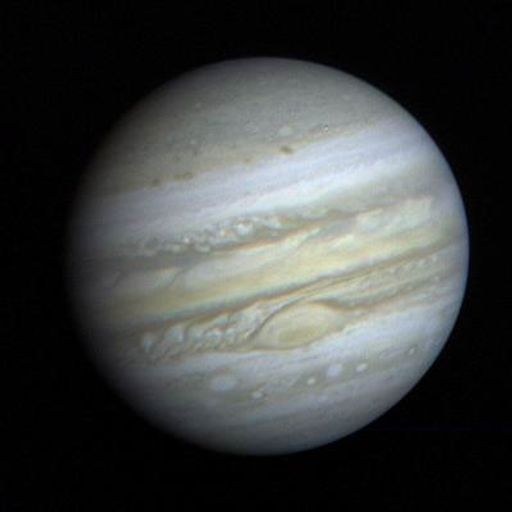
How it works: Jupiter's System II rotation period is 9h 55m 40.6s.
The GRS transits the central meridian once per rotation. It becomes visible about
2½ hours before transit and disappears about 2½ hours after, as it crosses the
visible hemisphere (~180° of longitude).
GRS Longitude: The GRS drifts slowly in System II coordinates.
Click "Sync IMCCE" to fetch the current longitude from the
IMCCE JGRS
web service (Paris Observatory). You can also check
JUPOS
or the BAA Jupiter Section
for reference. As of March 2026, it is near 40° System II.
Galilean Moons: Moon positions use the full Meeus/Lieske E5 theory
with complete perturbation series and light-time corrections. Event timing accuracy
is ~1 min (Io), ~3 min (Europa), ~7 min (Ganymede), ~15 min (Callisto),
verified against JPL Horizons. Events detected: transits (moon
crosses Jupiter's disk), shadow transits (moon's shadow on Jupiter), occultations
(moon behind Jupiter), and eclipses (moon in Jupiter's shadow).
Altitude/Azimuth: Uses a simplified planetary ephemeris accurate to
~1° for Jupiter's position. Set your location above or click "Locate me".
Events where Jupiter is below the horizon are shown in red.